
- Execution and scheduling: The enables the execution of pipelines within . It acts as the engine that carries out the tasks defined in the pipelines.
- Data locality: Your data will remain in the region your is running in, allowing you to conform to data locality limitations set by your organization or law.
- Scalability: The can scale up by running multiple instances concurrently, allowing for increased workload handling based on the user’s requirements.
You need a to run Streaming pipelines. This type has its own architecture considerations and installation procedure, which are covered under Create a .
Video example
Expand this box to watch our video about s.Architecture
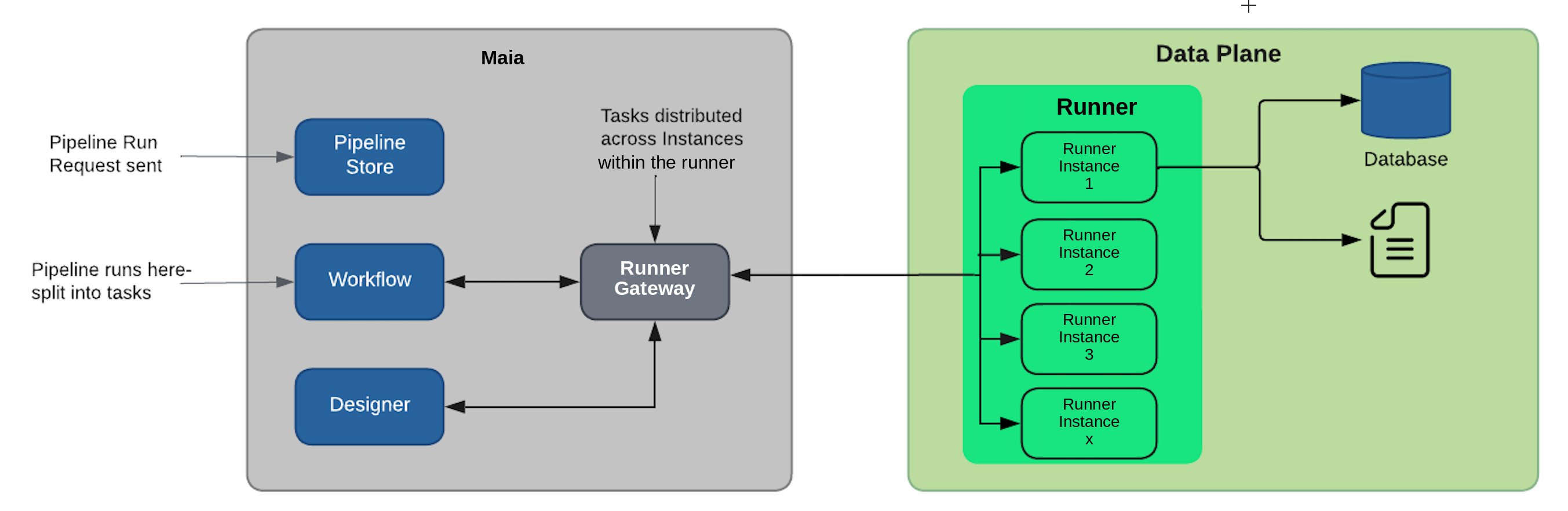
Matillion doesn’t currently support deployment in government cloud environments.
What is a data plane?
A data plane refers to an abstract concept that represents an execution environment. This execution environment, such as AWS Fargate, is used in conjunction with a provided by Matillion as a Docker image. The data plane serves as the infrastructure or environment where the instances operate. The instances, when deployed within the data plane, collectively form the . Each instance is responsible for executing individual pipeline tasks. These pipeline tasks typically involve interactions with various data sources, including a data warehouse. The data plane provides the necessary resources and infrastructure for the instances to execute the assigned pipeline tasks and perform data-related operations.What is Maia runner?
The is a software component responsible for executing the pipeline tasks within the specified environment. It serves as the execution engine for the pipelines and interacts with the runner gateway to receive the pipeline tasks that need to be executed. The communicates with the runner gateway using an egress-only method, meaning it can send requests and receive responses but can’t accept incoming connections. The pipeline tasks that are sent to the originate from platform. These tasks define the specific operations and transformations to be performed on the data within the pipeline.What is Maia runner manager?
The runner manager is an application or tool that facilitates the creation, configuration, and management of s within ecosystem. It is typically accessed through , where you can manage various aspects of the data pipelines. With the runner manager, users can create and define configurations for installing and deploying s. This includes specifying settings such as the image, environment variables, resource allocation, and any other required parameters. The runner manager provides a user-friendly interface or set of commands to simplify the process of configuring and setting up s.The runner manager offers functionality for managing s in compatible environments like AWS ECS Fargate. This includes features such as automatic updates, where the runner manager handles the process of updating s to newer versions seamlessly. This ensures that s deployed in compatible environments remain up to date with the latest features, bug fixes, and security patches. This means updates are controlled by Matillion, and as such, the user isn’t required to manually update the themselves.
Matillion Full SaaS vs Hybrid SaaS
provides two deployment models: Full SaaS and Hybrid SaaS.- With Full SaaS, Matillion manages the entire infrastructure, including deployment and security measures. Matillion ensures seamless updates and robust security protocols. The Matillion-hosted handles the execution of tasks, and customer secrets are securely stored in a Matillion-hosted secrets manager.
- With Hybrid SaaS, you deploy and manage your own s within your own cloud infrastructure. This gives you full control over security measures, network isolation, access control, and where your secrets are stored. This option is only available to customers on specific plans—visit the Pricing page to learn more.
- Custom JDBC drivers.
- SAP ODP.
- NetSuite SuiteAnalytics.
- Python Script. Use Python Pushdown instead in a Full SaaS deployment (Snowflake only).
Matillion Full SaaS
Every account is provided with a hosted by Matillion, providing a true zero-install experience. Each Full SaaS project is automatically provisioned with one Matillion-hosted at project creation. You can’t manually add or remove Full SaaS s—if you need additional runners, use Hybrid SaaS. If your projects are set up to use Matillion’s Full SaaS infrastructure then there is no need to be concerned with managing the —this is handled by Matillion. There’s no setup needed for a Full SaaS solution—it’s available for you to use straight away. If you need to allow any access from the Matillion Full SaaS to your data plane, you’ll find the IP addresses here. The Matillion Full SaaS scales automatically and supports approximately 20 concurrent tasks per instance. For more information, read scaling best practices. Full SaaS logs aren’t accessible to customers directly, since Matillion manages this infrastructure. If you need to view logs for a Full SaaS , contact Matillion support.Hybrid SaaS
If your account is on a plan that supports Hybrid SaaS, you also have the option to install our software within your own cloud infrastructure and data plane. This may be beneficial if:- Your data locality requirements need the to run in a specific region that Matillion doesn’t currently provide s in.
- You aim to achieve faster processing speeds by locating the close to your applications, databases, and cloud data warehouse.
- You need to access systems (such as database or file storage) that only have network access from within your VPC/VNet.
- You have specific scaling requirements that a Matillion Full SaaS doesn’t support.
- You need to use any of the Hybrid SaaS pipeline components listed above.
Migrating from Full SaaS to Hybrid SaaS
Projects are either Full SaaS or Hybrid SaaS, and can’t switch between the two. If you want to move Full SaaS workloads to Hybrid SaaS infrastructure, you need to perform the following steps:- Install the Hybrid SaaS in your infrastructure.
- Create a new project that uses your Hybrid SaaS .
- Recreate any secrets in the new project.
- Export and Import the pipelines from the Full SaaS project to your new Hybrid SaaS project.
- Recreate any schedules in the new project.
Maia runner version tracks
In a Hybrid SaaS deployment, it’s important that you always use a currently supported version of the , which means you will be required to update your from time to time. As we recognize that it’s not always possible or convenient to update as soon as a new version is released, we offer a choice of release cadences, which we call version tracks. The choices are Current and Stable:- Current: Supports the latest features and has a faster cadence for releases. This is usually twice a week, typically on a Tuesday and Thursday, though this may vary. These releases may include new features, bug fixes, and security patches. This track is ideal if you want to access the latest features as soon as they are available, and are able to update your frequently.
- Stable: Has a slower, more predictable cadence for releases. This is once per month, on the 1st of the month. Features added to a Stable release have previously been available on a Current release. We take a cut of the Current track on the first day of each month, and after a period of testing and verification we release this as the Stable version on the first day of the subsequent month. This means that any new features in a Stable release have been available for at least one month on the Current track.
- Changing the ‘s version track does not update the itself. You must update the image URI for the service in your cloud provider. If you don’t, the version may show as “Out of support”.
- If you change the state from Current to Stable and update the installed service, pipelines created using a newer (Current) version might not run as expected on an older (Stable) version.